
The short version
Give it three to six months. Rankings follow indexing and trust, not the other way round.
Chase long-tail phrases, not head terms. Most searches get ten or fewer hits a month, and specific beats broad.
Fix the technical basics before you publish. A slow, unindexed, or accidentally noindexed site cannot rank however good the writing is.
Track conversions, not just traffic. A rankings report full of green arrows means nothing if nobody converts.
Hire for judgement, not price. The cheapest quote is usually a junior account or bulk-bought content.
We see the same pattern over and over: a business pays for SEO for months, gets a handful of new blog posts and backlinks, and the rankings barely move. Before we touch a single keyword, we ask what happened. The answer is almost always the same: not that SEO does not work, but that one of a handful of common SEO mistakes was made early on, in South Africa or anywhere else for that matter.
Below are the five mistakes we see most often when a business is starting SEO for the first time. None of them are exotic. All of them are fixable, and most cost nothing to correct once you know they are there.
Expecting Results in Weeks, Not Months
The single biggest expectation mismatch is time. A poll of more than 3,600 marketers run by Ahrefs found that SEO typically takes three to six months to show meaningful results, and Google's own John Mueller has said it can take up to a year for Google to work out where a new or recently changed site belongs in its index. That is not an excuse agencies invent to buy themselves time. It is how the system works: Google has to crawl your site, understand it, compare it against everything else already ranking, and build enough trust to move it up.
If you started SEO four weeks ago and are already asking why you are not on page one, you are judging the work against the wrong clock. What you should be checking that early on is whether the technical foundations are in place, whether the right keywords have been identified, and whether early content is published and indexed. Rankings come after that, not instead of it.
Targeting Keywords Nobody Is Actually Typing
Most first attempts at keyword research start with guesswork: what do we call ourselves, what would we search for if we were a customer. The trouble is that head terms like "car insurance" or "plumber" are dominated by huge, well established competitors, and even if you rank, you are often chasing a term nobody types verbatim.
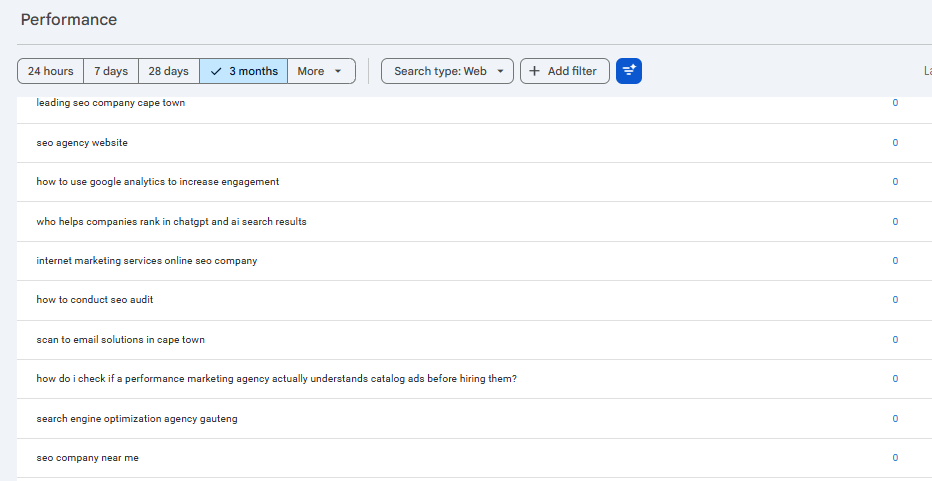
Ahrefs' analysis of Google's own keyword data found that 94.74% of search queries get ten or fewer searches a month. That sounds discouraging until you realise what it means: the real opportunity for a smaller or newer business is rarely the big obvious term. It is the long list of specific, local, commercial-intent phrases that add up to real traffic, things like "plumber Sandton emergency callout" rather than "plumbing services".
94.74% of search queries get ten or fewer searches a month.
Position matters more than most people expect too. The top three organic results take 68.7% of all clicks on a search page, and the first result alone averages a 39.8% click-through rate. Ranking eighth for a broad, competitive term is barely different from not ranking at all. Ranking first or second for ten specific, well-chosen terms beats it every time.
We use our 6W framework as the basis to uncover these nuggets rather than using guesswork.
The 6W framework: our way of replacing keyword guesswork with structure. Who we're targeting, where they are, why they buy, when they buy, what to say to them, and how we win the account.
Publishing Content Before Fixing What's Underneath It
It is tempting to start SEO with a blog, because content feels like the visible, satisfying part of the work. A beautifully written page on a site that loads slowly, is not verified in Google Search Console, or accidentally blocks search engines from key pages, will not rank however good the writing is.
Ahrefs' widely cited study of nearly a billion pages found that 96.55% of published content gets zero search traffic from Google, and a large share of that is not a writing problem. It is pages search engines never properly indexed, sites with no internal linking to guide search engines to the page, or technical issues nobody checked before hitting publish.
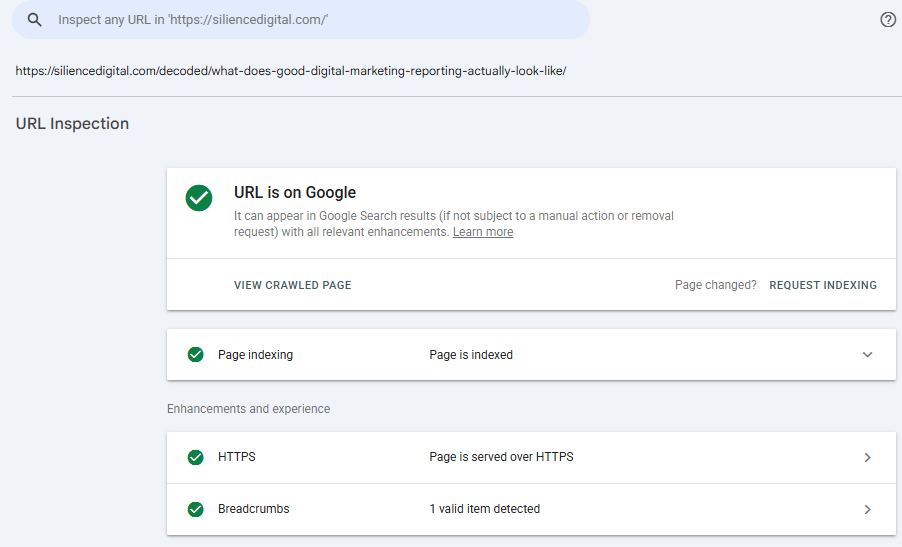
Before a single blog post goes live
Verify the site in Google Search Console
Confirm there is an XML sitemap, and that it has been submitted
Check the site loads quickly on mobile
Make sure nothing important is accidentally set to noindex
It takes an afternoon, and it is the difference between content that has a chance and content that was written for nobody.
Ranking For Something and Never Checking If It Made Money
Traffic is not the goal. It is easy to get excited about a rankings report full of green arrows and forget to ask the only question that matters: did any of this turn into an enquiry, a booking, or a sale?
We see this constantly with businesses who set up SEO but never connect it to Google Analytics goals, a CRM, or even a simple "how did you hear about us" question at the point of sale. Without that link, you cannot tell the difference between a keyword that brings in real buyers and one that brings in browsers who were never going to purchase, and you end up optimising for the wrong thing.
Before you spend another month on SEO, make sure you can answer this: which pages bring visitors, and which pages bring customers.
Hiring Whoever Is Cheapest, Not Whoever Is Right
Price is the easiest thing to compare between agencies and one of the worst predictors of results. SEO sold far below market rate is usually one of two things: a junior account run largely on templates, or backlinks and content bought in bulk from low quality sources that can do more harm than good.
The right question is not "what is the cheapest option", it is "who understands my business well enough to know which keywords, pages, and fixes actually matter". That is usually a smaller, senior-led setup, not the biggest name or the lowest quote. Ask any agency you are considering to explain, in plain language, what they would actually do in month one, and be wary of anyone who cannot answer specifically.
We provide a clear roadmap for each client so that you know exactly what to expect.
Common questions on getting SEO right from the start
Do we need to blog every week to rank?
No. Consistent, well-targeted content beats frequent, generic content. One strong page a month aimed at a real search term outperforms four rushed ones.
Should we just try to do it ourselves first?
If someone on your team has time and is willing to learn the technical basics above, there is no harm starting there. Just track results honestly, and get a second opinion before concluding SEO "does not work" for your business.
How do we know if our current SEO is actually working?
Ignore the rankings for a moment and check whether organic search is sending you enquiries, bookings, or sales you can trace back to it. If nobody can show you that link, that is the mistake to fix first, not the rankings.